“Rest assured, you need to talk to all your employees, the best information you receive will come from the cleaners and fork lift drivers.”
Waste - Aimless Walking
In many Viet Namese factories, the majority of small tools and day to day equipment is locked away in cabinets or cupboards due to an inherent fear that these work tools will be stolen. In many cases, even with the introduction of security cameras these small tools and equipment continue to be held in locked cupboards rather than kept on shadow boards or individual workers tools belts.
I have conducted many “time and motion” studies and have constantly noticed and recorded a reckless waste of time in walking to collect and return equipment. It is not a rare occurrence to see a drill operator for example,
· Walk from their machine to the cupboard to get a drill bit
· Unlock the cupboard
· Search for the drill bit and find it
· Lock the cupboard
· Walk from the cupboard back to their machine
· Discover that they have collected the wrong size drill bit
· Repeat the above
· Repeat the above again after collecting the wrong size drill bit for a second time
Even when the operator has only collected the wrong drill bit once, three minutes from a total observation time of 15 minutes has been wasted in needless (and aimless) walking between the machinery and the tool and equipment cupboard. Does 3 minutes in wasted time seem like a lot of time? No it doesn’t, but when you extrapolate this over the course of a day, month and year, this contributes to a vast amount of wasted production time and therefore profitability that anyone business can ill afford.
3 minutes from 15 minutes is 20% of the time period recorded.
20% of an 8 hour working day is 96 minutes
At 96 minutes a day over a 40 hour week we are looking at 480 minutes wasted or 1 entire day out of 5 days work wasted on needless (and aimless) walking.
20% of you wage overhead for zero to very limited productivity, however, as the employee was either moving or involved in opening and closing cupboards, a casual observor would see them as busy.
Waste - Searching for Equipment
Ranking not far after needless walking comes time wasted searching for tools and equipment.
Once your employee gets to the tool room, a tool room that will soon be moved to a location that is more efficient to access, we need to look to see if the tools used each day are efficiently stored.
Are the tools and other equipment kept in locked tool boxes or cupboards? Is time wasted continually locking and unlocking, opening and closing these tool boxes or cabinets.
Are the tools in a manner that each tool is easy to locate or are people wasting tiime searching for their tools and equipment?
Are the tools and other equipment organised so that everything the employee will use for one function be quickly collected and taken away per job or shift? When they are returned, can they be easily replaced where they belong and is that place the same place where they collected them from?
Do you have store keeper that can prepare each workers daily requirements, record what tool or piece of equipment has been issued to whom and when it is due to be returned.
Do you have store keeper that can record when each tool or piece of equipment is returned and more importantly follow up when tools and equipment are returned that they stored efficiently?
Most importantly is there are system or person nominated to follow up effectively when tools and equipment are not returned? Many of the above points become doubly important when “sharp” tools are involved in a packing area.
Once again, the bulleted points are just an indication of what to keep your eyes open for. Each industry will have its own foibles and quirks to look for. You as the business owner know your industry and workplace best. Or do you?
One tip just from me. Pick one place where you will leave your reading glasses and use it even if it’s out of your immediate area. You will save time when you are looking for them five minutes later. Habits are contagious.
Learn how to piggy back habits.
Waste - Excessive Inventory
From A to Z, excessive inventory is waste and is the one waste that we can and do measure. That’s right, excessive inventory is a waste that intrudes upon your administrative functions as well as the factory floor. We then are wasting more man power hours by having to continually count and record this waste. This is the reason Fire Sales were such a popular occurence in the past. I suppose they still have them now, just called something else.
Every aspect of your operations are at some stage a perfect example of excess waste.
Raw Materials, tools, machines, packing materials, ancilliaries, finished product, the motor pool, staff and workers, all will be in numbers larger than required at some point in the life of you operations.
Excessive inventory does not always have a financial cost in the first instance but before we know it, it is costing us, dealing with storage and administrations costs. I was at a export packing and shipping facility one day and was amazed by seeing carton boxes covering an area of about 200m2 in the product dispatch facility, a facility I would call the export warehouse. I chatted with the manager who was taking me around the premises and he turned beet red when I asked if they had a large order about to be packed and shipped.
It turned out that these carton boxes were excess inventory and a combination of occurrences meant that he could not get them removed. What happened was that the carton box manufacturer had decided that, as this company was a good customer, each time cartons were ordered they would produce and give them an additional 2% of the quantity ordered, Free of Charge. This was great at the start of the companies expanded operations but as the workers improved their skills and acumen, there was less and less need for any extra cartons, and nowhere near 2% additional cartons were ever required.
The instance of the 2% extra being delivered continued for quite a while as the Purchase Department thought they were the best ever negotiators getting all these extra’s for “free”.
I asked the Warehouse Manager how many carton boxes he had stored as excess inventory and again he looked like he had embarassed himself. As they were “free” they were not invoiced for and as they were not invoiced for, no-one had kept a count of them. It wasn’t as simple as counting 2% of what had been ordered as in earlier days they had used some, some had been used for other purposes and some had been removed as the rodents had found them. The Accountants wouldn’t count them as according to them they were not there and if they were there they had zero value and the company owner was of a mind to throw away nothing, “you never know.....” etc., I bet his fridge still has the stickers on it!
Maybe have the cartons recycled by the people who supplied them?
The upshot was that this “free” item was costing money by taking up usable floor space, creating a fire hazard and giving everyone a headache and this was becoming a wasted adminisitrative cost.
“Time waste is different from material waste in that there can be no salvage. The easiest of all wastes and the hardest to correct is the waste of time, because wasted time does not litter the floor like wasted material”
Waste - Operations best suited elsewhere
Ever seen someone welding near where the rags and paint thinners are kept? Ever seen quality controllers doing their inspections in the dimmest part of a factory floor?
I reckon you have seen this and more. I saw hospital staff using a chair to take items from the top shelf off a set of storage racks. In Australia! Lucky they were not far away from the Casualty Department. It’s just easier sometimes to go ahead and do what you need to do and to do it wherever you are.
But it is not good for efficiency or productivity. It can lead to poor quality of work, it can lead to injury to your workers or worst of all, it can cause major damage to your facilities.
Workers become familiar very quickly with bad habits. If It worked and if I got away with it once then why not do it again is an attitude you probably host hourly but never when you’re around. Make sure you look very closely when you are checking out your facilities for this type of waste.
TIP!
This is a tip I was given about 20 years ago and it works. If you, a member of your family but most importantly, your workforce, has a new habit that has to be learned, piggyback it on to an existing procedure that occurs daily and at a similar time.
Once you remind yourself that you put on your shoes after you put on your socks on just a few occasions, it will become second nature. Use it.
Waste - Excess Bending, Twisting & Turning
When you walk around your facilities, take a close look for workers who appear they would be more at home in an aerobics class than the factory floor. As an added concern, look for workers not lifting corectly and not working safely.
Let’s look at the scenario I came across in the factory producing furniture and how two simple steps increased the output on this particular production line by 30% and had the additional bonus of decreasing absenteeism through employees taking a lot less medical leave.
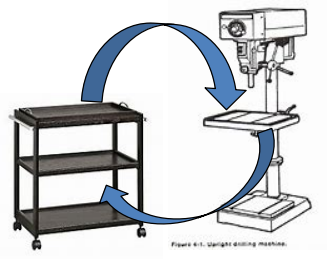
In the BEFORE imge below and after our GEMBA walk , note taking and discussions, we met with the workers and learned that the delivery of components to the drill operator on one trolley, then after the operator performed his function placing the components he had completed work on to the same trolley, this contributed to,
• The operators output was decreasing throughout the shift as he fatigued from continuously, twisting, turning and bending to collect and return the components to be worked on. They tired badly.
• Workers on this line took more sick leave than on any line in the production area. See above.
• The operator also had to move his trolley continuously as it had no brake on the wheels.
• The trolley continually moved into the clear-way as it had no brakes on the wheels.
• If his completed output was needed further down the line, the trolley could not be moved as it still had components on the trolley with work to be performed on them.
• The next operator on the line had to waste more time as his access to the components was difficult due to it being on a bottom, semi enclosed shelf.
By simply providing each operator with an additional, smaller trolley, with brakes, all of the above problems were eliminated and output increased.
BEFORE

AFTER
The next step to further increase production that we advised was to purchase better designed trolleys and most importantly, move the clear way to behind the workers and this meant moving the workers opposite each (back to back) closer to each other. Finally, we advised the employer to hire an additional worker and have them responsible for moving the components from worker to worker rather than have each operator collect and move the components. At times, the clear way for component movement was anything but clear.
Please do not fall for the trap that extra trolleys, or other equipment purchased, will solve all you problems with Waste.
Equipment such as trolleys will only be useful when changes to work practices are initiated as well. One thing I will always recommend is to talk with managers and workers as to whether Single Piece flow or Batch flow best suits this area of your operations.
Now let’s move onto 5s in greater depth
