The Myth of Busyness
How to Be Productive Without Losing Your Mind
In Busyness 1, I set out what I mean by busyness and why I believe it has become a modern way of life.
Before looking at how we might escape it, we need to understand what creates it in the first place.
In 1930, the celebrated economist, John Maynard Keynes predicted that his grand children and their peers would be employed but their employment would be for a total of 15 hours per week. Unlike today, we would be working for two days a week and that the weekend would total 5 days
Then why are some people still working 15 hours days? Technological advancements have decreased the physical performed work to a great extent but still, the long wasted hours persist.
Close to Home
My Dad was a plumber and gas fitter. He was employed for his entire working life, apprenticeship to retirement, by the one employer. To lift our family from working class to middle class he performed “homers”, of a weekend, when he could. These “cash in hand” jobs required him to have his own set of tools, materials and a storage area.
He introduced me to shadow boards, racking systems and an organised storage system before they were popularised. As a result, I was always an organised person (or at least I had it in me).
When it became time for me to instruct and encourage others to be organised and efficient, I needed a more formal system to be able to better get my message across. Many of the people I was working with had little formal education, many were educated in a system designed to persuade rather than to be inquisitive and some were just never going to accept change.
The Japanese go shopping and find their future
Three representatives of the Toyota Company visited the United States of America and looked at the assembly line processes at the Ford Motor Company, they were unimpressed. They also looked at the inventory system used at the Piggly Wiggly grocery stores. At Piggly Wiggly, they were impressed with the systems in place and yes, a store named Piggly Wiggly became the exemplar for the Toyota Production System.
The Toyota Production System has became the embodiment for the modern phenomena know as Lean and in particular it assisted them in developing 5S.
I chose the 5S Lean Methodology model as I was taken specifically by the promise that when implemented that the 5S methodology would offer every employee a level of importance within a company.
What do the 5 S’s represent?
As the 5S methodology was introduced by the now Toyota Motor Company, it is, as expected, that the original 5 S’s were written in the Japanese language. When the 5S methodology made its way to the United States and other Western countries, the 5 S’s were transliterated into English. As I began practicing the methodology in Viet Nam, the 5 S’s had been further transliterated into Viet Namese. I will show all three languages in the table below.
| Japanese | English | Viet Namese | |
|---|---|---|---|
| S1 | Seiri | Sort | Sàng lọc |
| S2 | Seiton | Set in Order | Sắp xếp |
| S3 | Seiso | Shine | Sạch sẽ |
| S4 | Seiketsu | Standardise | Săn sóc |
| S5 | Shitsuke | Sustain | Sẵn sang |
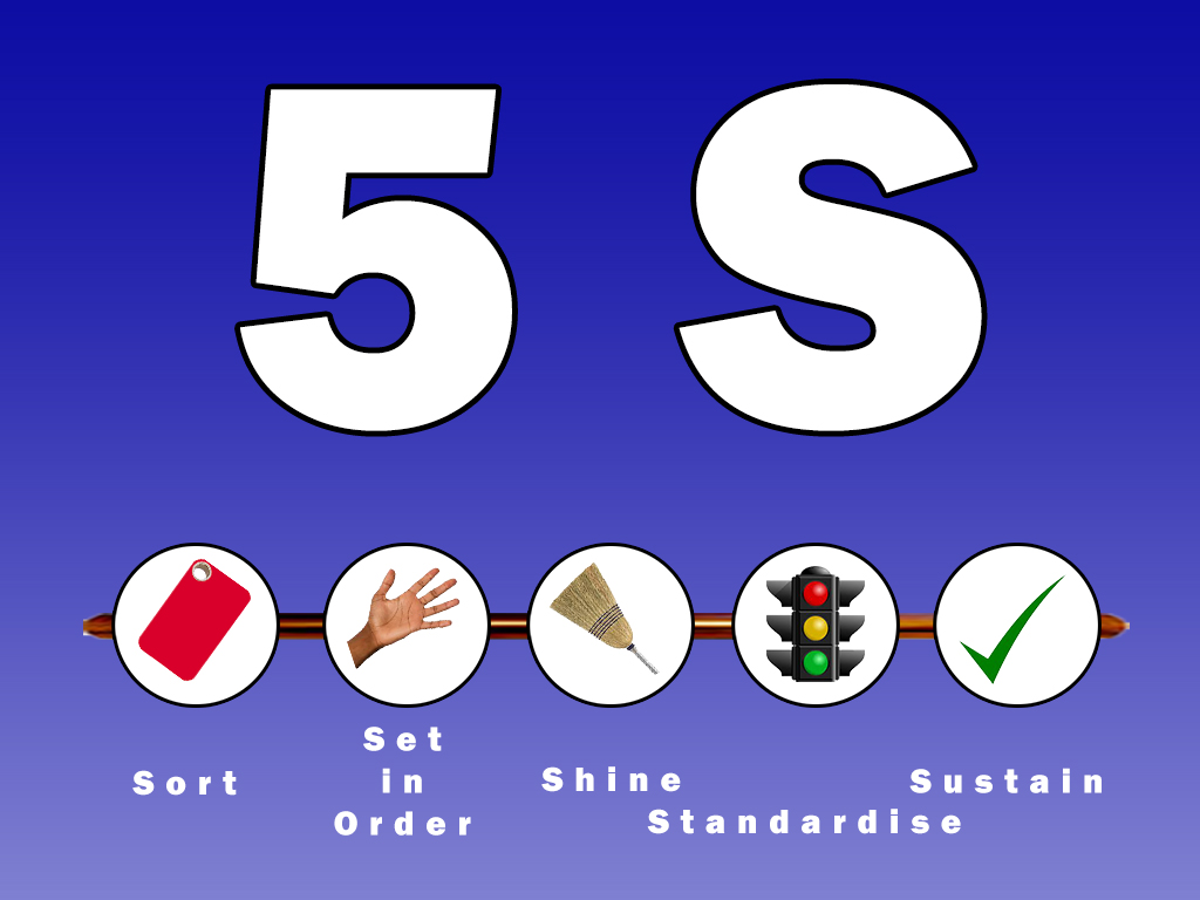
I will come back to the implementation of 5S later but what we need to recognise at this point, and in relation to busyness is, that, 5S is,
“how things can be improved”
to achieve
“greater efficiency in a better environment with the tools you need”
5S is Continuous Improvement
In its most basic form, 5S is all about the elimination of Waste.
The most common and most expensive form of waste is the “Waste of Time”.
The 5S methodology is all about eliminating that wasted time and providing you and your workers with what they need to do their job when they need it, no more, no less.
To make you more productive and less busy, we need to get you to eliminate the time that you are wasting. And yes, we all waste time. We want you to eliminate the time you waste and provide you with the mental as well as physical tools you need to do your job.
For this to be applicable to as many people as possible, there will be many sections that start with discussion based around production facilities. But what are all of us if not mini productions facilities? We will branch at times into administration and other business types. But everyone is smart enough to quickly discover how these situations become examples to all of us on a personal basis.
We may even give you the methods to keep your garage clean and tidy, have yourself a well organised kitchen or at a minimum keep your socks’n’jocks drawer tidy.
What are those Wastes?
The 5 biggest wastes in many production facilities are,
1. Aimless walking to get equipment, to return equipment, to get a drink etc., etc., etc.,
2. Searching for equipment.
3. Operations that would be best suited elsewhere.
4. Excessive inventory.
5. Bending, twisting and turning.
Could the 5 biggest wastes in an Administrative setting be,
1. Incomplete or ambiguous instructions
2. Searching for the correct instruction/information
3. Operations that would be best suited elsewhere, including, disorganized desks and work areas
4. Operations that are performed more than once or unnecessarily split between workers?
5. Communication that is not required?
Individually, we should use the abovementioned lists of 5 to look inside ourselves and give serious thought to where and when we are wasting time. Don’t skip this because you will get lots of advice and instruction on how you are wasting time but this advice and instruction is worthless unless you can find and recognise the waste yourself.
Honestly, it is a lot like what you would be told to do at many of the various Anonymous type organisations.
Key takeaway: To eliminate waste you first need to recognise it.
To help you in the journey to recognise your life of being a wastrel, I return to the Japanese and their concept of GEMBA, my capitalisation not theirs.
GEMBA is a vital first step in recognising the waste, take that step here,