Alexander the Great (Born 356 BC)
Alexander the Third of Macedon, horse trainer, avid lyre player and the guy who went on to be better known as Alexander the Great, was a great leader.
Alexander the Great was a remarkable leader who was and continues to be defined by his tactical brilliance many times through innovative tactics and who led from the front.
As a leader he led from the front, not shirking responsibilities and this combined with his ability to effectively communicate, led to him receiving great respect and loyalty from his troops. He was an inspirational leader.
Alexander's command structure allowed for quick adaptations in battle.
He often reorganized units based on the enemy's tactics and terrain, ensuring his forces could respond effectively to various challenges. This adaptability was crucial in his numerous victories across diverse landscapes.
He consulted his Commanders and listened to their opinions before making his final decisions
He is a legendary figure in both Greek and non-Greek cultures.
Captain James T Kirk (Born 2233)
While not recogonised as a great a leader as Alexander, Captain Kirk was a leader who recognised the need for diversity and consultation. A noted ladies man, Kirk had full trust in Uhura as his Communications officer and used Spock, a Vulcan/Human hybrid, as a dispassionate and logic driven sounding board against his own impulsiveness.
Kirk was a leader who was always able to put himself in the position that his underlings and also his enemies were currently facing. This enabled him to react quickly to situations that looked like getting out of control. He considered the opinions of his crew without fail but tended to make his own decisions and then acceptinging responsibility for those decisions. This galvanised his team.
A great leader will use the pronoun “I” when taking responsibility for results that did not go as planned. They will always use the pronoun “we” when reporting on results that have gone well.
He made many important decisions, including his most famous decision, with a willingness to take risks for the greater good rather them personal fame.
He did have a tendency to ignore orders at times. This tendency must be reined in
You may have read or heard the statement that “a team of champions will always be beaten by a champion team”. What fails to be mentioned, is that the champion team will always be very well led.
The army of sheep being led by a lion. The team of champions will be difficult to lead, they are army of lions being led by the sheep.
When you are a leader you should be looking for a champion team, the members of that will participate, cooperate and join forces as required. They will have a capacity to do this naturally and not require constant instruction.
In a team, the team that you will lead, you do not want people, who even though highly knowledgeable and skilful, will operate as individuals. There is no cohesion among individuals and they will waste more time and this wasted time will contribute to wasted finances.
Recreational Angling
“Fishing leaders add an additional layer of strength to your fishing line”.
It is such an apt description of a leader that when we change it to represent a team of any type and in this conversation a business team, it does not lose any of its meaning. We can change it to,
“Team leaders add an additional layer of strength to your team”.
The full text from the fishing site reads,
“Fishing leaders provide an additional layer of strength to your fishing line, preventing it from breaking when a large fish takes the bait. Thus, increasing your chances of catching a fish. No matter what fishing style you use or the species you want to target, choose only high-quality fishing leaders and fishing lines available at Tackle World”.
It would be a terrific exercise for you to take the above description and adjust it to suit your situation.
It is also an exercise to be used in any educational setting. Have your team, the future leaders condier how they view leadership and how they prepare for it.
I use a similarly worded sentence as a question to be verbally asked at hir interviews. If, of course, I am involved. Most medium to large businesses would have a HR section and if you have chosen the correct HR professional, they should be making the employment decisions in most instances.
Are leaders born as leaders or does your upbringing contribute to whether you will be a leader or a follower? Is leadership thrust upon some when others just assume a leadership role? Does everyone have the ability to become a leader?
In my life, I thought that I was just a natural leader, however as I matured and looked back on my upbringing, I realised more and more that my upbringing played a major role in my development as a leader. I had great role models in my parents. They were leaders themselves and as we look up to our parents while we mature, their leaderships abilities where something I just naturally followed. I was a nurtured leader.
My father Ron was coaching footballs teams and as a family going to the footy was a huge part of my earliest memories. Watching “big” people hang on my Dads every word when he addressed them fascinated me as a kid. Becoming the team mascot, as I suppose a five year old, for the first time in my life made me part of a team and that was a terrific feeling for me. Being part of a real team is still terrific all these years later. Every team needs a leader and you cannot put your leadership skills to the test without a team.
To be a successful leader you need to gain respect and respect is gained through actions and achievements. You will not be a successful leader if you think that it is your position that should get respect.
Sure, when you are in primary school you will become the captain of school sporting teams because you are the best player. You are the big fish in the small pond. If you show real leadership skills in those early days, the people responsible for your development, parents and teachers, will naturally push you towards leadership roles in other pursuits, academically and socially. From early in you life you are taking responsibility for others. The question is, how do we become better leaders?
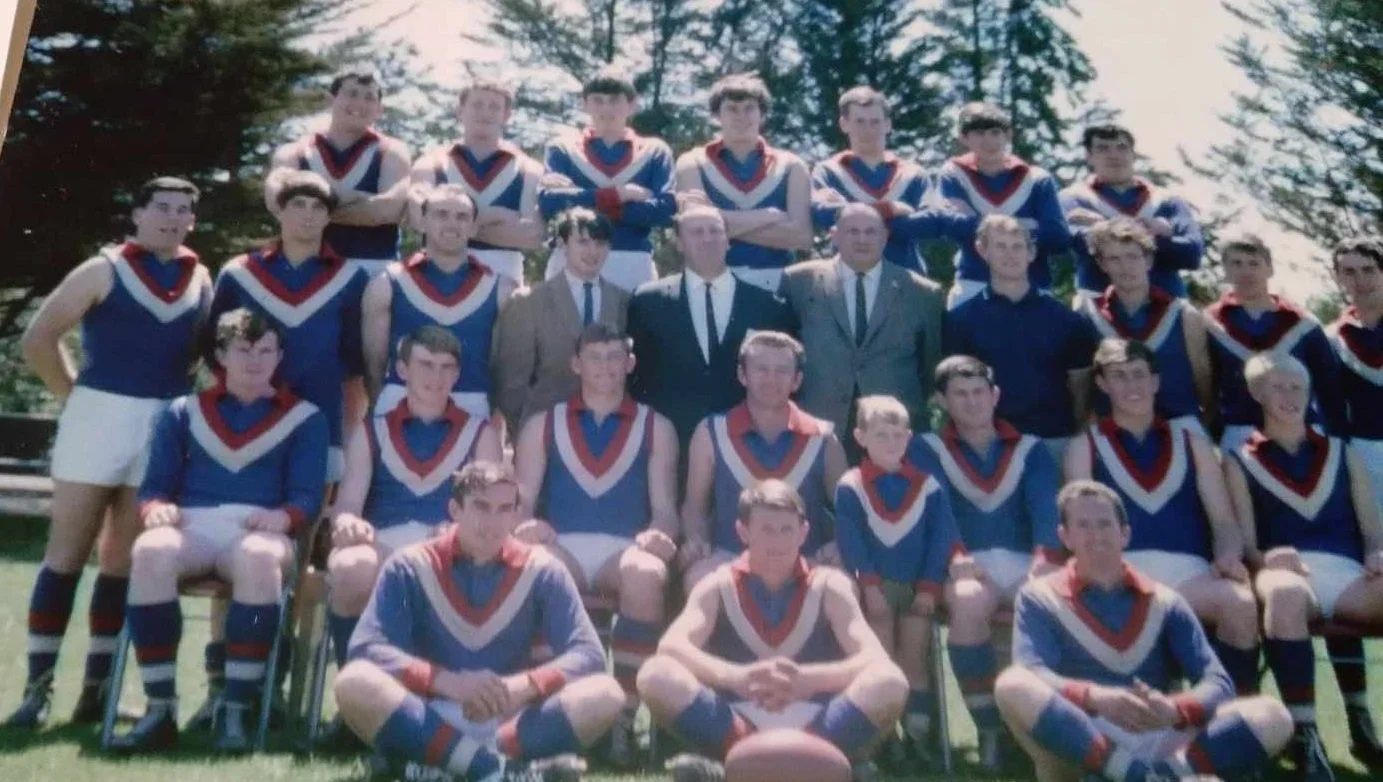
Yes, that’s me, the little tacker.
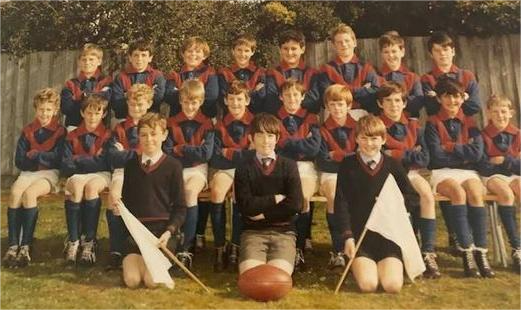
Still the smallest of the lot in my second team.
All Work & No Play
I am the firm belief that every person should be part of a team early in life. I would recommend a sporting team but I know that this is not for everyone. Whatever the type of team it must have some aspect of competition plus cooperation with others. My Asian friends will say this is foolishness as there is no spare time when growing up, these kids should be doing additional study or extra homework. Fine if you wish to develop adults that are socially awkward adults with little or no idea how to interact with other people through their teenage years to adulthood. You are not giving them the chance to become leaders. They do not have to be the best player, they need to learn how to work with all types of people. The world needs all the leaders they can get, give your kids the chance to become a truly great leader. And one final thing, don’t try to relive your life through your children, be a leader to them.
Heroes
You can probably arrive at the fact from reading the above that my first Hero was Ron and you are correct. You will also answer correctly if you conclude that sport played a huge part of my early life. My heroes then were all sportsmen.
Ian Chappell
Unsurprising to many who know me and those who have a need to get to know me a lot of my characteristics were copied from Chappelli. Chappell was known for being blunt and forthright in his views and didn’t tolerate those he considered fools but had a determination and a sense of fair play for all.
Leading cricketing broadcaster John Arlott called him "a cricketer of effect rather than the graces".
Chappell’s actions led me to respect him from afar and he become an influence on my growth.
Who are your heroes?
Who are your heroes and how have they affected your life. I suppose it depends on when and where you were raised and in what type of social and education system.
The following list is sure to have a lot of people who call them heroes.
Mahatma Gandhi, Nelson Mandela, Ronald Reagan, Wayne Gretsky, Oprah Winfrey, Bono, Winston Churchill, Marie Curie, Shaka Zulu, Sun Tzu, Sitting Bull.
I think it is a great idea to revisit with your heroes throughout your life and see how they shaped you and are you still being faithful to the ideas they helped you develop. It is also a great idea to see if you still see these people in the same light. History has a habit of highlighting the bad rather than the good, many times with good reason. Does it change your views of these people and does it have an effect on how you live and lead? Think Lance Armstrong, O J Simpson, Rudy Giuliani, Ellen Degeneres and Bill Cosby for some. A bit of a self assessment is almost never a bad thing. Does a fall from grace mean you wipe the lessons learned from others forever?
Apart from Chappell, some of the people I admire and learnt lessons from include, Galileo, Emmeline Pankhurst, Peter Lalor, Peekay, Leigh Matthews and Michelle Payne. And from a non human point of view? Vo Rogue, another great leader.
We are all susceptible to making mistakes, learn from them and do not make them a habit. Whether you realise it or not you will be watched by many but more by your team and again, without your knowledge you may becoming a “hero” to them.
The thing with all great leaders, either leaders of teams or leaders in their chosen field is that they challenge the status quo, they push (and cross boundaries) and they do not accept being told that something cannot be done. The remarkable story of Roger Bannister is something everyone should study. Briefly, he decided he would be the first man to break a 4 minute mile in athletics, a feat “they” said couldn’t be done. Bannister eventually broke the four minutes mile but that is not what appeals the most. He lead the way by crossing the boundary of the 4 minute mile, leading the way for others to realise the possibility. Within 12 months, 5 other athletes had also broken the 4 minute mile, a feat previously thought impossible.
“It is the brain, not the heart or lungs, that is the critical organ.”
Conclusion
Being a strong, thoughtful and considerate leader will be an asset to making both you and your team productive.