The Myth of Busyness: How to Be Productive Without Losing Your Mind
Does geometry, shape your time?
Until fairly recently, I thought that Isoceles was a person, but no, it is not. Not only does that prove that we can always learn something new, it more than likely proves that I was not paying attention in class that day.
Of course, the triangle man was Pythagoras (circa 570 - 495BC). What I like about Pythagoras is that he was a contrarian and that, still today, not one single detail of his early life goes unquestioned by historians. What is not contradicted is his theorem, that the area of the square whose side is the hypotenuse (the side opposite the right angle) is equal to the sum of the areas of the squares on the other two sides.
Another prominent person who loved a triangle was Nobel Peace prize winner and humanitarian Arch Bishop Desmond Tutu who asked the question,
“Have you seen a symphony orchestra? There is a person at the back carrying a triangle. Now and again the conductor will point to him or her and that person will play "ting." That might seem so insignificant, but in the conception of the composer something irreplaceable would be lost to the total beauty of the symphony if that "ting" did not happen".
Triangles whether large or tiny have a huge influence on our lives that we almost always fail to appreciate. Triangles are everywhere and what triangles offer us is support.
A single triangle receives compression from the top and the tension is on the bottom or base.
It is accepted that a triangle cannot be distorted by stress. A number of triangles in a series is how truss bridges are constructed and they give the bridge(s) a stable form capable of supporting considerable external loads over a large span.
We use triangles in organisational charts and I suspect that many managers or budding managers were imagining how the Collingwood coaching panel would have looked like in org. chart form. Without actually belonging to this group, how would you have perceived what the groups structure was. You may have even placed yourself in this group.
It is my opinion that every orgnisation, whatever the purpose of that organisation, requires a ordered structure. If an ordered structure does not exist, those at the near top of the structure use their perceptions, usually highlighting themselves, as to how the structure exists. If for no other reason and at the very minimum, you must develop an informal structure for the purpose of effective communications. If it is possible and you have the level of seniority required, you should attempt (and achieve) to have a formal structure installed.
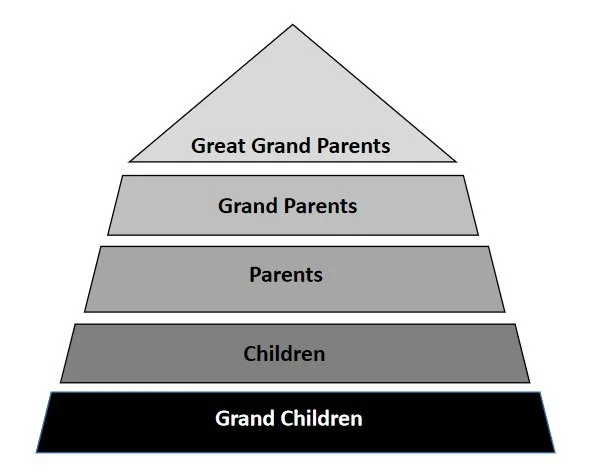
The most common structural hierarchy that we are all a part of is the family unit.
The business structural hierarchy is based on the family structure.
The family structure is basically the same everywhere. In its simplest form it works well.
Every person in the structure is knowledgeable about their place in the structure.
When we get to a business structure, within the actual structure there is not that much difference to the family structure. Those with more experience, seniority or responsibility sit on the top. Conversely the less experienced, younger and possibly with zero responsibility sit at the bottom.
There is a saying that was literally taken by some and that saying was that,
“children should be seen and not heard”
This saying was most often used to reprimand children who showed “disrespect” by trying to interfere in a conversation between adults. It was also used to slightly reprimand parents who allowed their children to be present during adult conversations particularly conversations deem inappropriate for children to hear.
In practice, the meaning generally was taken that children are allowed to be present during adult conversations but should not partake in the conversation unless they are specifically ask to contribute. One child being asked a question did not give open approval for other children to contribute.
When looking at the business or company structure, let’s imagine for now that if this was also the family structure, that,
The General Manager is your parents.
The Department Heads are you (in the middle) with you brother to the left of you and your sister to the right of you.
The Section Heads are your and your siblings children and you each have three children.
Both the family and company structure will be shaped like triangles.
Rather, the traditional company structure or hierarchy is a triangle. And like our truss bridge, the compression maybe called Standard Operating Procedures (maybe orders) come from the top or the Executive. The tension (demand) is placed upon the base, the workers.
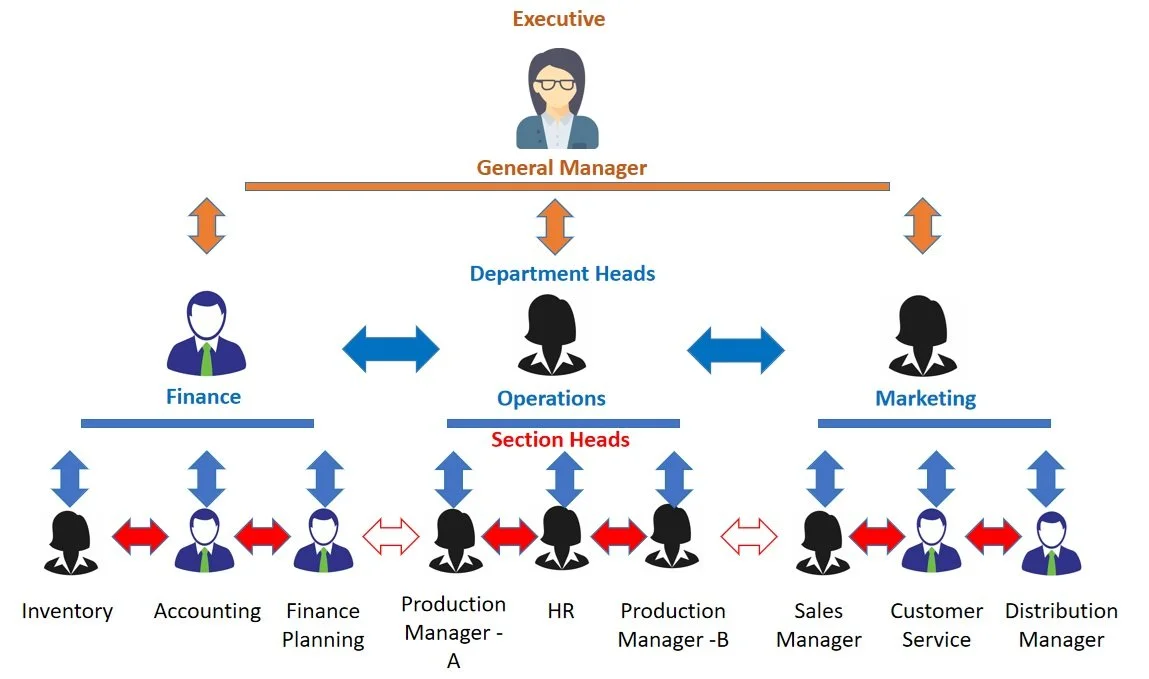
The parents (General Manager) in this structure will talk to their children (Department Heads) as a group or individually.
The parents in this structure, now Grand parents (General Manager) can talk directly to their grand children (Section Heads) but it is unlikely, or unwise to, issue direct instructions to the grand children (Section Heads) without first alerting or talking to the parents (Department Heads)
The siblings will talk between themselves and if they have a question for the Uncle and/or their siblings father, they will ask the appropriate sibling, their peer, to ask the question to their parent.
This is the correct method of conducting successful and respectful communications.
As we noted previously, people and as a result of people, sub-groups were joined together by jigsaw pieces with their blanks and interjambs. The blanks and interjambs are located on the sides of the pieces, the run side to side and top to bottom. There no connecting pieces on the corners so to use our previous description of the blanks and interjambs representing mouth and ears, communication should not be passed downwards and very rarely upwards on a diagonal basis.

Communication should take place from the blanks and interjambs and NOT from the corners.
Communication is side to side and top to bottom and bottom to top.
Communication is not diagonal.
To use an example from the organisation structure previously shown, the Operations Manager should not be giving instruction to,
Inventory Manager, the Accounting Manager or the Financial Planning Manager.
This applies to all Managers.
Returning to the family unit, you would not abide it if your brother or sister was giving instructions directly to your children. If it is unacceptable in the family structure, why would anyone consider it acceptable in business?
Not only is it discourteous but managers cannot manage if they are not aware of what duties their people are performing for others.
It creates disharmony amongst peer to peer management.
Empowerment
CEO’s, company owners and people at other senior levels can (and do) give instruction(s) to whoever they want and sometimes for no other reason is the that person is the closest person to hand. Busyness through inappropriate tasks being carried out by the incorrect person occurs. Chaos can follow.
One of the topics that Senior Management must have and make a decision about, and also reiterate on a regular basis, is to empower their employee’s to act in one of three ways
Politely say NO with an explanation as to why they are saying NO to the person giving the instruction.
Advise the boss giving the instruction that that is not their role but they will pass the information to whoevers task it is.
Take on the project/task AFTER reporting it to and getting the permission from their immediate supervisor.
Additionally, this person should be have the right to ask for clarification (in writing) of the given task.
Even if it is the correct person that has been given the instruction, that person must feel comfortable that they can ask for written clarification of the task given. Ambiguous tasks are often given by bosses/owners assuming that everone person has as much knowledge and understanding as they themselves do.
Once again, correct and clear communication is vital to success. We always want to have all employees have “buy in” to having the company succeed. If they feel that they are being given unclear instructions or misplaced instructions, people will feel less motivated to succeed.
If employee’s feel that they are not allowed to contribute suggestions that they feel may improve the companies performance they will become less motivated to succeed. Employee’s who are confident enough to make suggestions are also smart enough to know that not all, or indeed any, of the suggestions will be implemented within the business. It is the feeling that they are being respected as a person who will be at least listened to that motivates and achieves “buy in”.
Again, the blanks and interjambs that connect people are representations of mouths and ears.
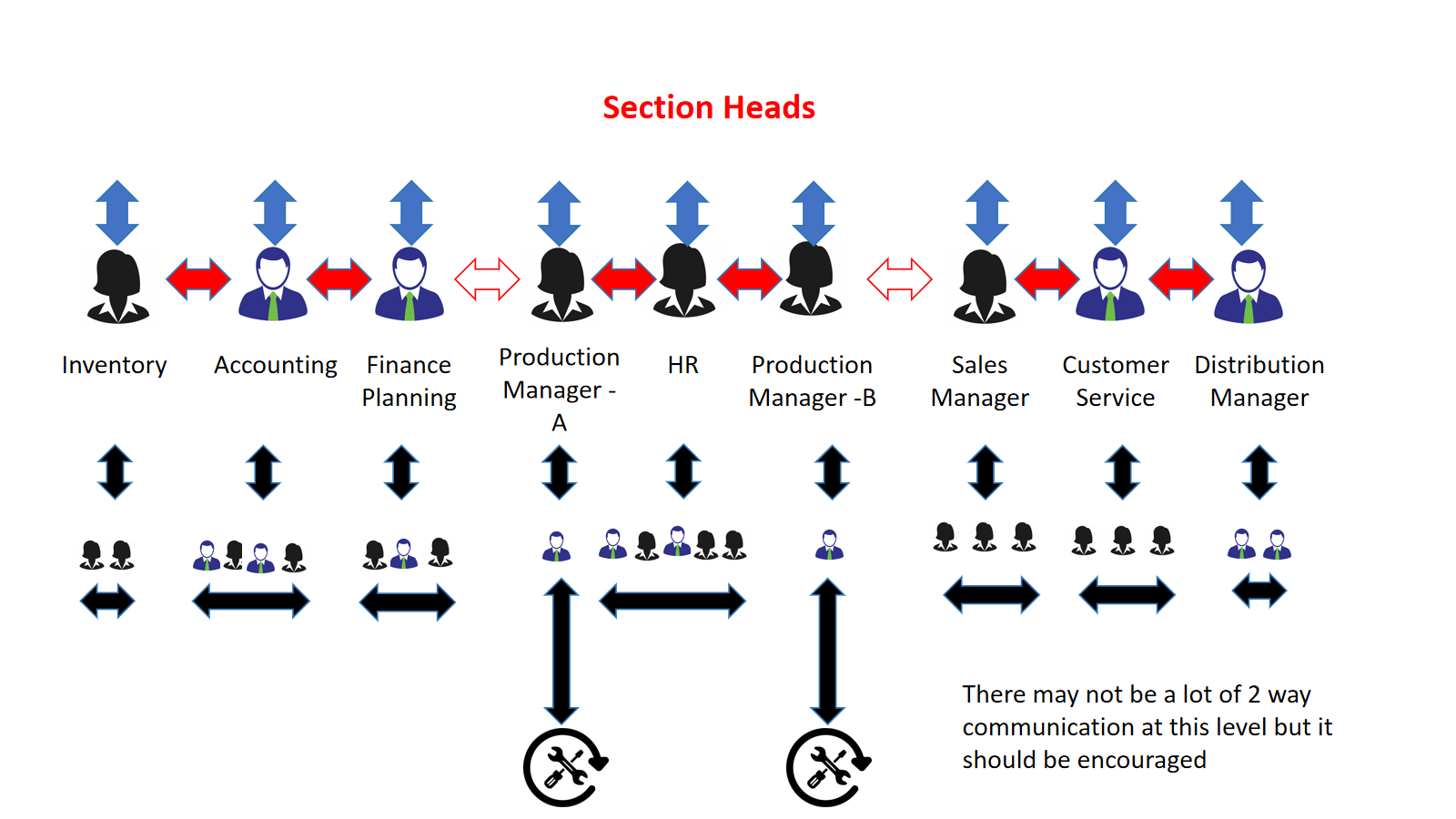
As we get toward the base of our hierarchical structure the same type of communication channels should stay the same. As managers, we should always encourage full tiers of workers to have their say. At the worker level, their say will more likely be conveyed by their immediate supervisor or even by a Union representative.
Your workers are participating in Gemba every day. The “place where it happens” is the place they know best. Do not let any intellectual snobbery that you may not be even aware of clouds you feelings towards those carrying out the work, FOR YOU.
At all levels, but importantly when listening to the workers, either directly or indirectly through the communication channels, the best policy that everyone should be well aware of is,
“when you come to me with a problem, I also expect to hear your proposed solution”.
As we travel further down the hierarchical structure, the greater the chance is that we will discover cultural diversity whether that diversity is educational, where someone was born or raised or simply that greater opportunities were available to some, we must make sure that everyone feels comfortable making a contributon to the companies improvement.
All too often, diversity is viewed as being in conflict with performance; something that leaders will get around to once they’ve decided who will contribute to discussions and who will not. However, the evidence that the diversity of ideas improves communications (and performance) is overwhelming.
Those unwilling to contribute or unwilling to consider a change of viewpoint are spectators. Businesses require participants not spectators.
Advantages of our triangle shaped hierarchy
The triangle shape provides us and our work force with many benefits. The effectiveness of the triangle makes our company become productive and not busy (busy wasting time). Further, it will help management measure employee satisfaction.
Clear Career Paths
Advancement Opportunities: Employees can easily identify their potential career path within the organization.
Motivation and Morale: Being aware of the rungs where the steps on the career ladder can bolster employee motivation and productivity.
HR Clarity: The Human Resource section can design a scale of compensation that helps with the above points but also assists with annual payroll budgeting. It will also allow HR to advise potential recruits what the payment is for the role for which they are being spoken to about.
Company Loyalty
Team Cohesion: Employees often develop strong attachments to the company, this promotes teamwork and collaboration.
Shared Goals: A clear structure will allows departments and the company in its entirety to align individual and sectional objectives with the overall goals of the company.
Our final point above may remind of the success story we visited, the winning Collingwood football team of 2023. However, lets not get too carried away with our business comparing itself with a successful sporting team.
I would suggest that it is rare indeed that all members of a business management team would have the same goal as a sporting team and this is to be expected.
A sporting teams goals are seasonal events
There will always be an employee who is using their current position merely as a stepping stone to a better position, usually elsewhere. As long as they operate to their best, and those looking to climb the ladder, wherever that ladder should be, normally will, they will be good team members.
The efforts of a business team have the efforts rewarded in different ways. A business teams best efforts create the most reward for the owner or shareholders of the business.
Some people are not going to more productive, work longer hours or contribute fully if they are minimally rewarded for their day to day contributions or are not rewarded at all for efforts over and above their contracted agreement. You cannot change human nature. A contract is contained within the 4 corners of the paper it is written on. Flexibility is a two way street. Reward for effort is not always so.
SILOS
All businesses, sporting teams and society in general need silos and create solos and these silos can define the character of any and all organisations. How you manage your silos is one of the keys to becoming organised, efficient and ultimately succesful.
Silos are normally defined as specialty teams. Both legal and medical firms are perfect examples of where specialty teams flourish.
More often than not we only hear about the negative effects of siloing so before a management team go on a rampage and start knocking down and eliminating silos, let’s have a look at the positives that having silos contribute towards an oreganisations success. After all, there must be a reason the silos keep being built.
They keep the experts in their fields accomodated together
When all the experts of a specific field of work are located together, it enables those experts to focus on their field of expertise and enables the future experts to receive knowledge from the more experienced. This is a positive.
Structure & Accountability
All of the positives that we visited in the Structure section above can be achieved in a silo. A silo provides a clear boundary and a clear hierarchy so that each person within the silo knows their place in that silo, their responsibilities within that silo and the aims of that silo.
This enables the resources available to that silo to be allocated correctly and that when decisions are made that they can be communicated quickly within the silo. This is positive.
A Sense of Identity and Belonging
Silos can create stability within a team and create norms such as Standard Operating Procedures and protocols. This helps promote a sense of identity for the team and a predicatbility in the way that work is conducted for ALL the experts gathered within the silo regardless of their position within the silo.
So,
Silos within an organisation have a clear purpose and belong in organisations as they have positives. So why do we always hear the bad wraps that silos receive?
We know and have more than likely experienced the unwelcome effects of these vertical structures but the solution is not to knock the silos over or to disassemble them.
To preserve the strength of silos we need to construct bridges or platforms between them. We covered this is the Structure sections and it all comes down to communication.
When we initially started to discuss company/business structure we also discussed families and sporting teams both organisations that have specific team functions. But they also have smaller teams withing them, with Collingwood we discussed the Forward, Midfield and Defensive teams. In the family unit we had you brothers and sisters.
And in both these organisations, especially the sporting teams, we spoke about the imperative of communication. Let’s look at that subject again.
Communication is the key, communication is what is required to build the bridges between individual silos the that our silos, that can be exceptional on their own can also contribute to the success of other silos around them.
In the same way that the different coaches communicated effectively amongst themselves, communicated effectively with the Senior Coach on an up and down basis and communicated effectively with their individual teams on a down and up basis so can our Senior Managers such as Department Heads.
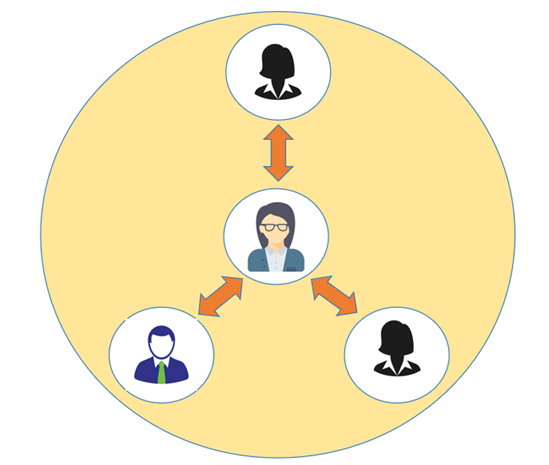
The above image is a copy of our earlier Management Tier in the hierarchy structure but from a birdseye view. The orange two way arrows that previously indicted two way communication still do the same but as we can see the barriers to each Department Head in the form of a silo, we need to remind ourselves that barriers exist and that we must make a conscious effort to remove these barriers to communicate effectively.
The above is repeated, again as per the hierarchy structure, up and down and sideways to the Section Heads and worker level.
We just need to maintain and encourage communiction.
The Dartboard Structure
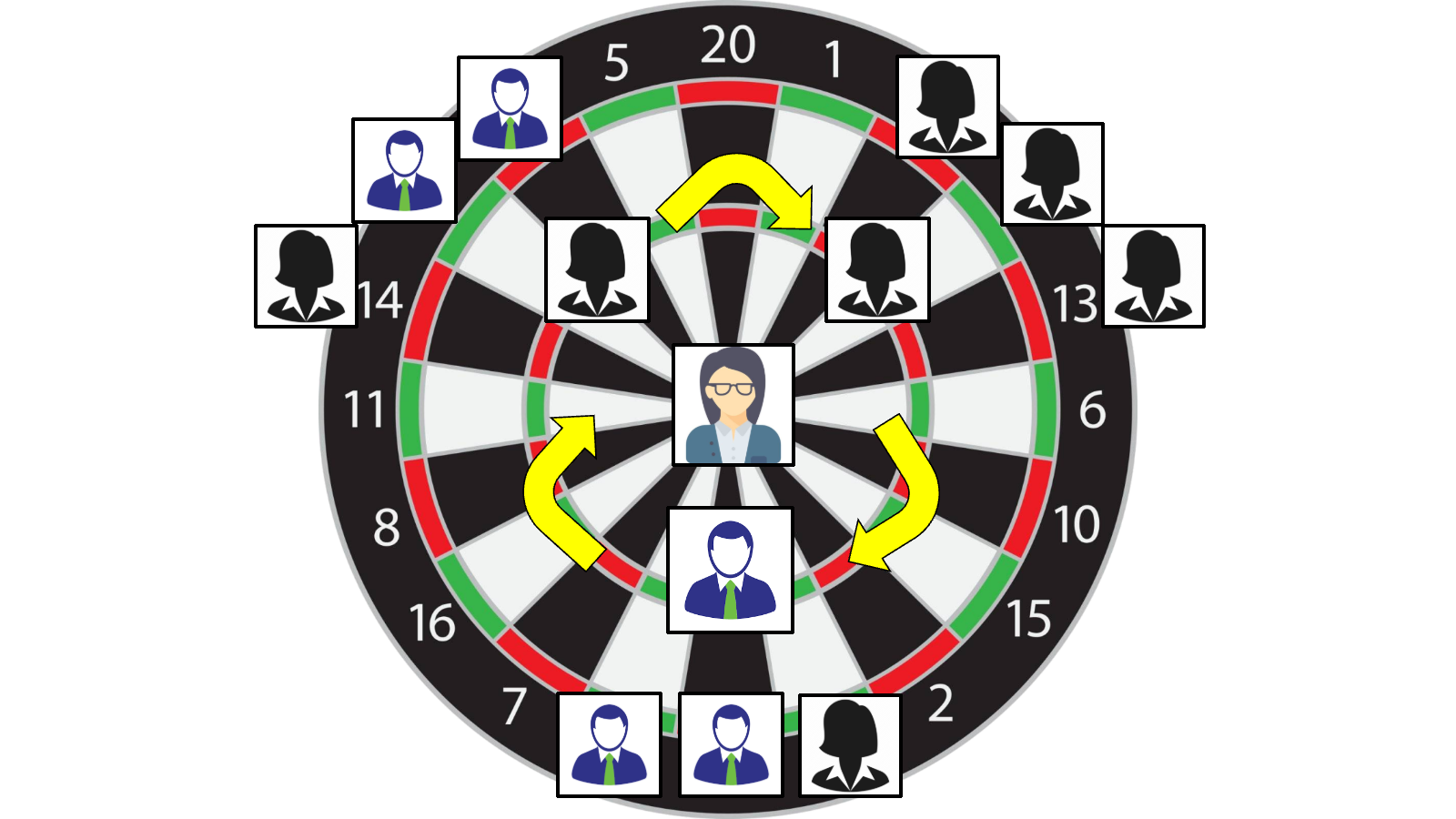
When we look at the birdseye view of our original pyramid structure it resembles a dart board with our General Manager as the bulls eye, the Department Heads as the triples and Section Heads as the doubles, the highest scoring and therefore most important areas of the dart board.
The dartboard is also made up of triangles.
What I have tried as a Management training tool, when I have had the opportunity, is to rotate the Department Heads through the Departments so that they gain experience in Departments that are not their area of expertise. This tool works best when all Departments are stationed at the one location. The “real” Department Head is never too far away in case of an emergency, this gives each Department Head confidence to move away from their silo.
A further actual bonus is this further encourages communication as the Department Head will need to discuss matters that they are not totally familiar with and with staff that they have not had a prior close working relationship with.
The appreciation for the work performed by other Departments begins to sprout. A good leader will then encouraged staff from their main Department and staff from their temporary Department to both appreciate each other and to communicate and work with each other rather than work against each other(s). Thoughts, ideas, practices and goals are continuing to align.
A Flatter Structure
Holacracy: A less centralised organisational and management system through which decision-making takes place democratically and flatly through management teams within the the hierarchy as desribed above.
I will not spend too much time on these flatter structures as I believe that they do not work well in the long term.
It is my opinion that while they may achieve some purpose early on after implementation, they tend to progress along the following lines. They quickly become anything but democratic
If we refer back to our Busyness BAMM’s one of the most destrctive of them was, Busy and Micro-Managing.
Let us remind ourselves now what we need to be aware of,
Busy and Micro-Managing:
Micro-Managing saps confidence and kills productivity. Leaders should guide and support, not control every detail. A good manager moves the elephant forward — not pick the fleas off it.
Micro managing is a lousy method of managing, it saps the confidence, motivation and purpose from those who thought they had been entrusted with responsibility.
It does not encourage productivity and Continuous Improvement.
The micro manager must know that they have this ability to influence, sometimes a great deal of influence and this influence must be a positive influence, not a harmful one.
My favorite saying for this one is “is that you don’t buy a dog and then bark yourself”.
The flatter structure basically removes a level of management we referred to in our original management structure. We had named that level Department Heads. The flatter structure therefore has the Sections Heads being directly responsible to the General Manager. This setup will delight the micro-managing General Manager but create busyness at mega levels.
If it possible that the Section Head level can operate by itself, the following tends to occur,
The most senior Section Head will see themselves as the “Chairperson” of the group and attempt to take control.
If a “Chairperson” does not arise a seniority based clique will form.
Either with or without the above one or two occurences the loudest but not necessarily the brightest will dominate meetings of this group, communication from all is soon discouraged as this happens and this will lead to communications at and between all levels being misused. Confusion reign as staff and workers will not know who to take direction from and any particular time.
Once communication channels have been misused, the cliques and the loudest within the cliques turn inportant meetings at this level into “what we achieved last week“ forums and patting themselves on the back rather than what the real purpose of these meetings is, learning and improving from past performance and preparing for what the upcoming tasks are.
We soon have a group of leaders constantly patting themselves on the back completely oblivious to any problems that maybe forming.
There is always a time to celebrate and celebrating the achievement of a stated goal, particularly a goal that was a shared objective, should be celebrated. But keep your feet on the ground, keep yourself and your team focused and get over one celebration with an eye to the following one. Keep everyone aligned.